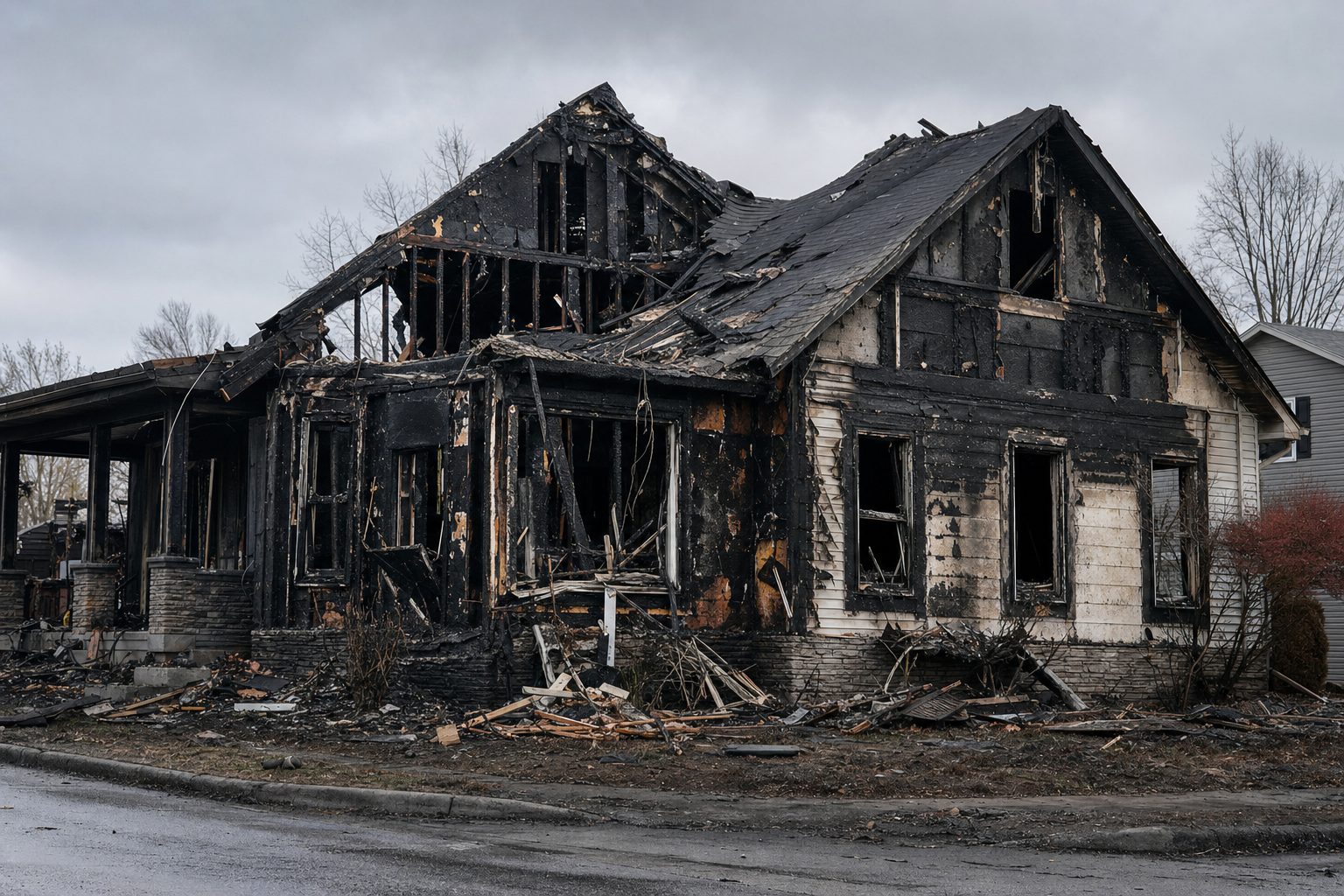
Putting out a structural fire creates a secondary water emergency. Fire department hoses and activated sprinkler systems can introduce hundreds of gallons of water into a home. The fire is out, but the water damage is just beginning, and it is more complex than a standard water loss.
The Fire Is Out. Now You Have a Water Emergency Too.
This is one of the most difficult realities of a structural fire. The suppression that saves the home from burning also creates water damage that must be addressed alongside the fire and smoke remediation. These are simultaneous, intertwined damage types that cannot be addressed in isolation.
A single activated sprinkler head discharges 8 to 24 gallons per minute. In a room where multiple heads activate, the water volume is substantial in a very short time. Fire department suppression from exterior and interior lines can introduce even greater volumes.
A home saved from the fire can sustain severe water damage from the water used to save it.
Why Fire Suppression Water Is Different from a Pipe Burst
A clean water pipe burst starts as Category 1 under ANSI/IICRC S500. Fire suppression water is different from the moment it contacts the structure:
- It typically enters from above (from sprinkler heads in ceilings or from hoses directed at upper walls and rooflines), soaking ceiling materials, attic insulation, and upper floor framing
- It has mixed with fire residue, soot, ash, and smoke contamination, meaning it carries contamination from the fire into every surface it contacts
- It contacts fire-weakened structural materials, which creates additional structural risk during water extraction and drying operations
- It creates a complex damage pattern where some areas are fire-damaged, some are water-damaged, and many are both simultaneously
This is among the most complex damage scenarios in residential restoration. It requires coordinated assessment and simultaneous response tracks, not sequential treatment.
What Combined Fire and Water Damage Requires
A home that has experienced both fire and fire suppression water damage needs:
Structural safety assessment first: Before any restoration work begins, the structural integrity of the fire and water-affected areas must be confirmed. Water-soaked structural components that were also heat-compromised present a combined risk profile that exceeds either damage type alone.
Complete documentation before work begins: Matterport 3D scanning captures the full scope of all damage types in their original condition before any materials are disturbed. This record is the foundation of everything that follows.
Simultaneous extraction and smoke assessment: Water extraction from floors, walls, and structural cavities cannot wait for smoke remediation to be completed first. Both must proceed in coordinated parallel.
HVAC assessment for both damage types: The HVAC system may have been affected by smoke during the fire and by water from suppression. Both contamination types require assessment and addressing in the same system.
Contents restoration addressing both damage types: Personal property in the affected areas may have fire and smoke damage, water damage, or both simultaneously. Each item requires appropriate treatment for its specific damage profile.
A Story from Lindale: The Living Room That Took Water from Above
A homeowner in Lindale had a fire that originated in the kitchen and activated the sprinkler system before the fire department arrived. By the time the fire was extinguished, the kitchen had fire damage and heavy smoke contamination. The living room adjacent to the kitchen had no fire damage, but the sprinkler activation had soaked the ceiling drywall, pushed water into the wall cavity on the shared kitchen wall, and saturated the carpet and subfloor across the central area of the room.
The living room damage was entirely water damage from suppression, with no direct fire exposure. The ceiling drywall in that room held enough water weight that it was at risk of failure.
Cantt Restoration documented both damage zones with Matterport 3D scanning before any work began. Water extraction and structural drying in the living room proceeded in parallel with smoke assessment in the kitchen. The two tracks were managed as a single coordinated job, not two separate jobs that might create gaps between them.
The full scope of what the sprinkler activation had done to the living room would not have been apparent without moisture mapping. The surface carpet looked wet. The wall cavity behind the shared wall and the ceiling assembly above were also saturated, which the thermal scan confirmed.
How Cantt Restoration Handles Combined Losses
We assess fire damage and water damage simultaneously from the first moment on site. We do not separate fire restoration and water restoration into independent job scopes that leave gaps between them.
Complete Matterport 3D scanning documentation before any work begins captures the full scope of all damage types. Moisture mapping with FLIR thermal imaging confirms water migration beyond the visually affected area. All work follows ANSI/IICRC S520 for fire and smoke and ANSI/IICRC S500 for the water component.
Call Cantt Restoration 24/7
If your home has experienced a fire with sprinkler activation or fire department suppression, call us now. The water damage is active.
Cantt Restoration: (903) 251-9525
Sometimes the damage is minimal and you might not need us. We will tell you that too.
This content is for general informational purposes only and does not constitute legal, insurance, or professional restoration advice. Cantt Restoration is not a policy expert, attorney, or public adjuster. Every loss situation is unique. For questions about your coverage, contact your insurance company, adjuster, or agent directly. For assessment of your specific situation, consult a qualified restoration professional. Cantt Restoration follows ANSI/IICRC S500, S520, and S740 standards on every job.
Call Cantt Restoration 24/7
We respond around the clock across East Texas. On-site within the hour.
(903) 251-9525Sometimes the damage is minimal and you might not need us. We will tell you that too.