
Mold
Remediation.
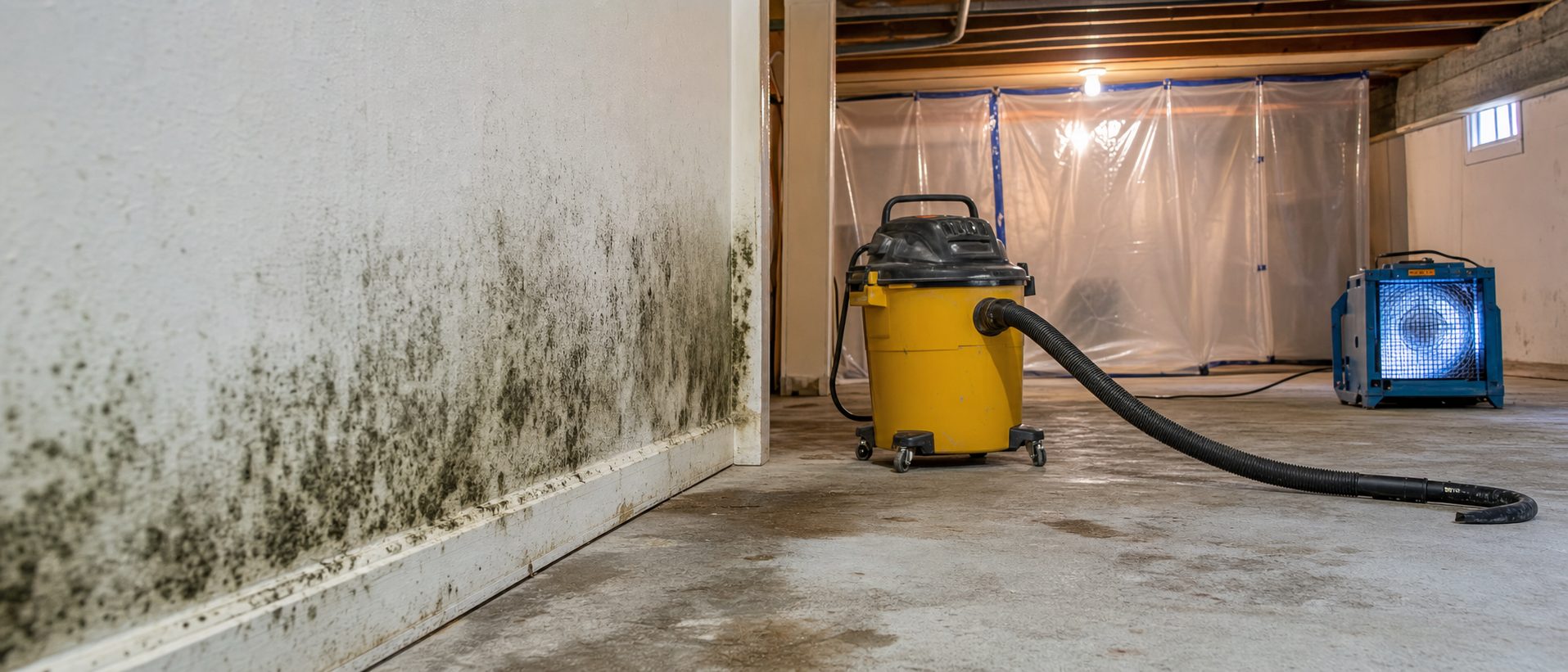
Mold (what restoration professionals classify as microbial growth) requires a moisture source to grow. We identify the source, coordinate licensed remediation, and verify clearance following ANSI/IICRC S520 standards across East Texas.
What We Do
Mold Remediation in East Texas
Mold (what restoration professionals classify as microbial growth) requires a moisture source to grow. Cantt Restoration identifies the source, coordinates licensed remediation, and verifies clearance following ANSI/IICRC S520 standards. Mold remediation in Texas requires a state license under Chapter 1958 of the Texas Occupations Code. Cantt Restoration partners with licensed mold remediation subcontractors for all remediation work.
Moisture Source Identification
Mold cannot be successfully remediated while active moisture intrusion continues. We identify the source using FLIR thermal imaging and the Extech MO290-RK contractor kit, mapping elevated moisture readings across the full affected area.
Professional Assessment
Visible mold is rarely the full extent of growth. Colonies frequently develop inside wall cavities, under flooring, and behind cabinets. We assess the full scope before remediation begins so nothing is missed.
Containment and Negative Air
Licensed subcontractors establish negative-air containment to prevent spore dispersal to unaffected areas during remediation. This is a required protocol under ANSI/IICRC S520.
HEPA Filtration
HEPA air scrubbers capture airborne spores during and after remediation. HEPA vacuums are used for surface cleaning to prevent spore redistribution.
Post-Remediation Verification
We coordinate post-remediation clearance testing through an independent third-party laboratory to verify that remediation was successful before containment is removed and the space is re-occupied.
Contents Evaluation
Mold-affected contents require individual assessment. Soft goods, documents, and porous materials may require specialized cleaning or disposal. See our contents restoration page for the full process.
We follow ANSI/IICRC standards on every job. The science does not change based on the size of the loss.
Cantt Restoration — East Texas
Understanding Mold
Why Does Mold Grow Inside Walls in East Texas?
East Texas sits in a climate zone where outdoor relative humidity frequently exceeds 80 percent during summer months. When moisture enters a wall assembly through a slow plumbing leak, storm intrusion, or condensation on improperly insulated surfaces, it creates an environment where mold (microbial growth) can establish within 24-48 hours. The insulating materials inside wall cavities, fiberglass batt, cellulose, and the paper facing on drywall, are all cellulosic substrates that support mold growth.
In a Chandler-area home we assessed, a slow leak at a dishwasher supply line had gone undetected for approximately six weeks. The visible damage on the cabinet floor was minor. Moisture mapping revealed elevated readings extending into the adjacent wall cavity, under the laminate flooring, and into the subfloor assembly beneath. The actual mold remediation scope was considerably larger than the visible footprint suggested.
The EPA mold guidance and ANSI/IICRC S520 both emphasize that moisture source correction must precede or accompany remediation, or regrowth is certain.
Licensing Disclosure
Texas Mold Remediation Licensing Requirements
Mold remediation in Texas requires a state license under Chapter 1958 of the Texas Occupations Code. Cantt Restoration coordinates mold remediation projects through licensed mold remediation subcontractors who hold all required state licenses. Cantt manages assessment, coordination, documentation, and verification of the remediation process.
Send Us a Photo. No Obligation.
Not sure how bad it is? Send us a photo and we will give you an honest assessment. No sales call. No pressure.
Photos of the affected area only. No need to include people, faces, or children. Avoid photos showing personal documents or ID cards. One or two clear photos is plenty. Photos submitted through this form are used solely to assess your situation and are not shared, sold, or published without your written consent.
Immediate Steps
What To Do If You Find Mold
Finding mold (what restoration professionals classify as microbial growth) in your home or property is unsettling, but the steps you take in the first hour matter. Acting correctly limits exposure, preserves your options, and gives any restoration team a cleaner starting point. Here is what to do.
-
1
Stop the moisture source first.
Microbial growth cannot be successfully remediated while active moisture continues. If a pipe is leaking, turn off the water supply. If intrusion is coming through the building envelope after a storm, block or cover the opening if it is safe to do so. Address the source before anything else. Every hour of continued moisture extends the affected area.
-
2
Do not disturb visible mold.
Do not scrub the surface, apply bleach, or treat porous materials with chlorine-based products. Disturbing a mold colony without proper containment releases large quantities of spores into the air and spreads them to areas that were previously unaffected. Leave visible growth exactly as you found it until a professional assessment is completed.
-
3
Restrict the area.
Limit foot traffic in and out of the affected room. If possible, close the HVAC vents in that space so the system does not carry spores to other parts of the building. Keep children and pets away from the area. The less disturbance, the smaller the remediation footprint is likely to be.
-
4
Document with video first, then photographs.
Before you move or touch anything, walk through the space with your phone camera running. A continuous video sweep captures context that individual photographs miss, including odor indicators, proximity to moisture sources, and the full extent of visible growth. After the video walkthrough, take still photographs of each affected area. This record protects you through the entire insurance and remediation process.
-
5
Call Cantt Restoration at (903) 251-9525.
Visible mold is rarely the full extent of the problem. Colonies of microbial growth frequently develop inside wall cavities, under flooring, and behind cabinets, well before they become visible at the surface. A professional assessment with moisture mapping identifies where growth is active and where conditions support its continuation. Call us and we will walk you through what to expect.
Sometimes the damage is minimal and you might not need us. We will tell you that too.
Questions
Mold Remediation: Frequently Asked Questions
What is mold remediation and how does it work?
Mold remediation is the process of identifying, containing, and removing mold from a structure. The process follows ANSI/IICRC S520 standards and includes moisture source identification, negative-air containment, HEPA filtration, removal of affected materials, and post-remediation verification through independent laboratory testing.
Does mold remediation in Texas require a license?
Yes. Mold remediation in Texas requires a state license under Chapter 1958 of the Texas Occupations Code. Cantt Restoration partners with licensed mold remediation subcontractors for all remediation work.
Can I clean mold myself with bleach?
No. Bleach does not penetrate to kill the root structure (hyphae) on porous surfaces like drywall or wood. It removes the visible stain while leaving the colony intact to regrow. Disturbing mold colonies without proper containment also releases spores into the air. Professional assessment is the correct approach.
How do I know if I have mold inside my walls?
Persistent musty odor without a visible source, water stains on drywall, or discoloration at wall-floor junctions are common indicators. Moisture mapping with calibrated meters can identify elevated readings in wall cavities where mold is developing before it becomes visible.
This content is for general informational purposes only and does not constitute legal, insurance, or professional restoration advice. Cantt Restoration is not a policy expert, attorney, or public adjuster. Every loss situation is unique. For questions about your coverage, contact your insurance company, adjuster, or agent directly. For assessment of your specific situation, consult a qualified restoration professional. Cantt Restoration follows ANSI/IICRC S500, S520, and S740 standards on every job.
Mold Does Not Wait.
Available 24 hours a day, 7 days a week. Call us for a professional assessment.
(903) 251-9525