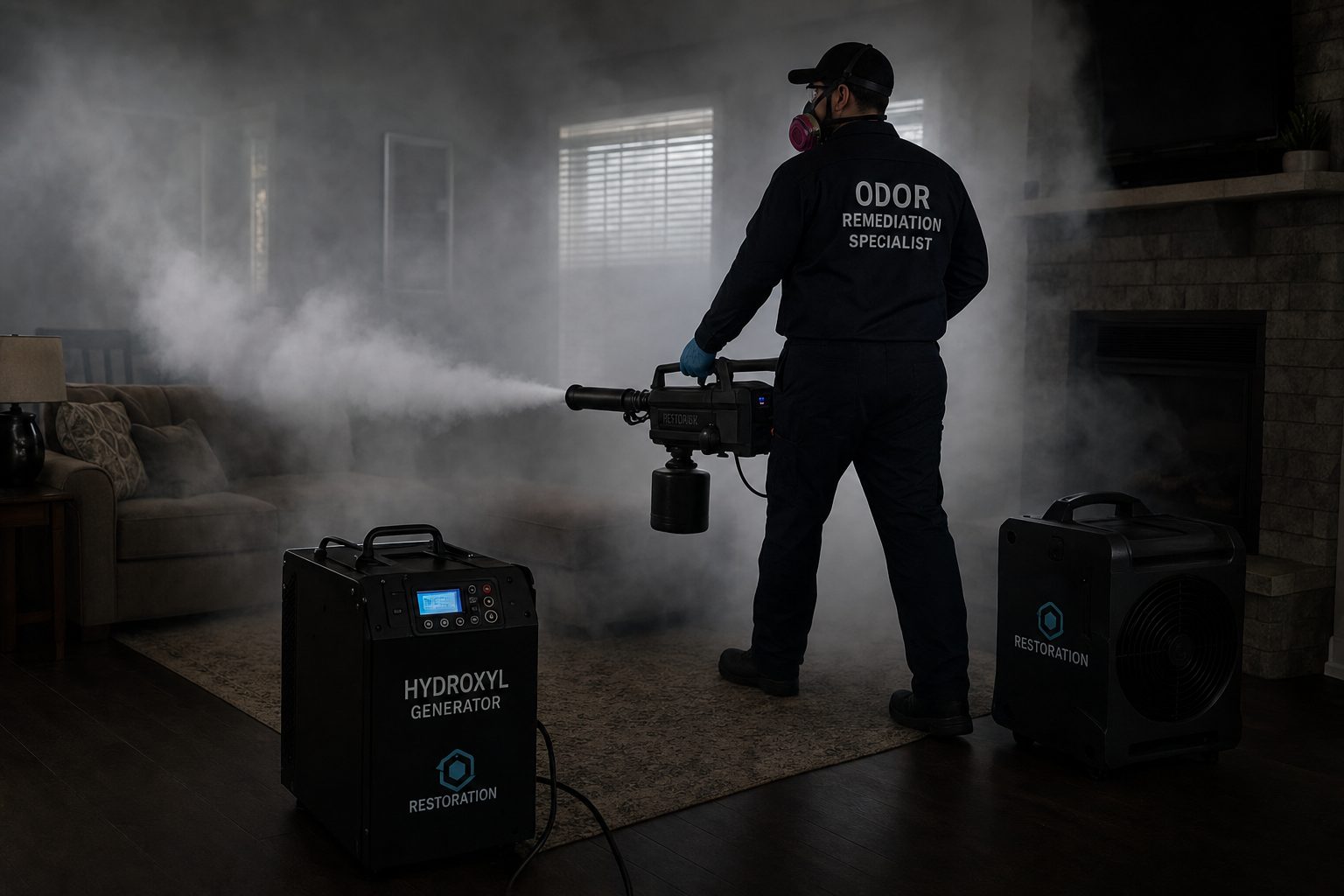
You cleaned the soot. You repainted the walls. You lit candles and bought air fresheners. The smoke odor is still there, stronger on warm days and impossible to ignore when the house is closed up. This is not a cleaning failure. Smoke odor that persists after surface cleaning is a physics problem, and masking it will never solve it.
Why Smoke Odor Comes Back
This is one of the most consistent follow-up calls we receive. A homeowner cleaned visible soot from a fire, repainted, and believed the odor would resolve on its own. Months later, the smell is still present and sometimes worse than it was initially.
Here is why: smoke is not a surface contaminant. During a fire, smoke particles (some smaller than 0.01 microns) penetrate deep into every porous material they contact. These particles do not stay on the surface. They travel into:
- The gypsum core and paper face of drywall, and into the stud cavities behind it
- Wood framing, especially rough-cut lumber where the grain is more open
- Insulation batts and blown insulation, where odor molecules settle and are almost impossible to remove without material replacement
- Every duct surface, coil, and blower component the HVAC system has that was running during or after the fire
- Upholstery, carpet fiber, books, and clothing at a molecular level
Painting over smoke-damaged walls creates a temporary barrier. When temperatures rise, the odor molecules off-gas back through the paint. This is why the smell intensifies in summer and on warm days. The paint did not eliminate the odor. It delayed the expression of it.
What Professional Odor Elimination Actually Does
Professional smoke odor elimination does not mask. It destroys the molecules responsible for the odor. Three primary methods are used, often in combination:
Thermal Fogging
Thermal fogging disperses a deodorizing agent as an extremely fine fog using heat. The particle size of the fog is calibrated to match the particle size of smoke penetration. The fog penetrates the same porous surfaces that smoke penetrated, reaching into wall cavities, carpet backing, and deep wood grain. The deodorizing agent neutralizes odor molecules chemically on contact.
Ozone Treatment
Ozone generators produce O3, a molecule that reacts with and destroys odor molecules on contact. The reaction breaks down the compound responsible for the odor into benign byproducts. Ozone reaches every surface that air contacts, including inside walls and HVAC ducts.
Ozone treatment requires that people, pets, and plants vacate the space during treatment. The process is thorough precisely because it operates throughout the entire air volume of the structure.
HEPA Air Scrubbing
High-efficiency particulate air scrubbers remove fine smoke particles from the air that are not visible but contribute to persistent odor. Air scrubbing is often used in combination with thermal fogging and ozone as part of a comprehensive odor elimination approach.
A Story from Cuney: The Kitchen Fire That Would Not Stop Smelling
A homeowner in Cuney had a kitchen fire that damaged the stove area and produced heavy smoke throughout the connected open floor plan. The family had the visible soot wiped down, the walls repainted, and the flooring replaced. They moved back in believing the worst was behind them.
Eight months later, they called because the smoke smell had never left. It was worst in summer when the air conditioning was running.
When we assessed the property, two things were clear. The HVAC system had never been cleaned and was actively circulating residual soot particles from the ducts into the living space with every cycle. Second, the wall cavities in the kitchen area still carried smoke penetration that had not been addressed by the surface repainting.
Comprehensive odor treatment, including HVAC cleaning, thermal fogging to address the wall cavity penetration, and ozone treatment, resolved what surface work had left behind.
Cantt Restoration Eliminates the Source
We do not recommend masking products. We address smoke odor at its source: the porous building materials and HVAC components that absorbed smoke molecules during the fire event.
Every fire restoration we perform that includes a smoke odor component is evaluated for the full penetration depth and the appropriate combination of treatment methods for the specific materials and conditions.
Call Cantt Restoration 24/7
If smoke odor has persisted in your home after a fire, or if you have recently experienced a fire event and want it addressed properly the first time, call us now.
Cantt Restoration: (903) 251-9525
Sometimes the damage is minimal and you might not need us. We will tell you that too.
This content is for general informational purposes only and does not constitute legal, insurance, or professional restoration advice. Cantt Restoration is not a policy expert, attorney, or public adjuster. Every loss situation is unique. For questions about your coverage, contact your insurance company, adjuster, or agent directly. For assessment of your specific situation, consult a qualified restoration professional. Cantt Restoration follows ANSI/IICRC S500, S520, and S740 standards on every job.
Call Cantt Restoration 24/7
We respond around the clock across East Texas. On-site within the hour.
(903) 251-9525Sometimes the damage is minimal and you might not need us. We will tell you that too.