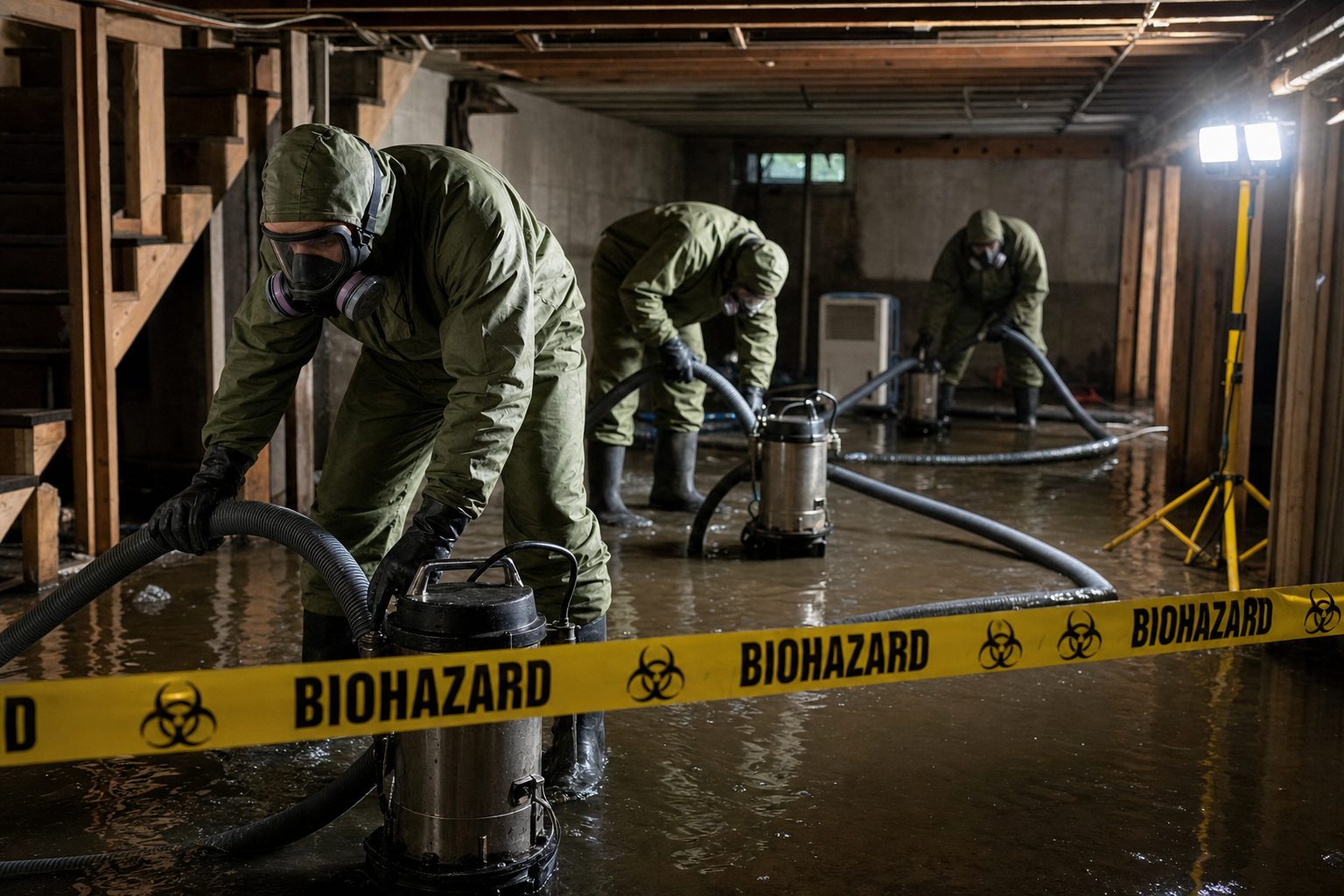
Sewage backup is a Category 3 biohazard event. Raw sewage contains bacteria, viruses, fungi, and parasites that cause serious illness. If sewage has backed up into your home, leave the affected area immediately and call Cantt Restoration. Do not attempt to clean it yourself.
Do Not Touch It. Do Not Walk Through It. Call Us.
A sewage backup is not a plumbing inconvenience that you mop up and move on from. It is one of the most hazardous contamination events that can occur inside a home. Direct contact, even brief, creates health risks. The area must be treated as a biohazard from the moment of discovery.
If sewage backup has affected your home, leave the affected area immediately. Do not walk through it. Do not attempt any cleanup. Call us first.
What Is in Sewage Backup
Raw sewage is classified as Category 3 (grossly contaminated water) under ANSI/IICRC S500. The contamination it carries is not theoretical. It includes:
- Fecal bacteria: E. coli, Salmonella, and other organisms capable of causing severe gastrointestinal illness and, in vulnerable individuals, more serious systemic illness
- Hepatitis A virus: Present in fecal matter and transmissible through contact or inadvertent ingestion
- Parasites: Including Cryptosporidium and Giardia, which are highly resistant to standard household disinfectants
- Fungi and mold (what restoration professionals classify as microbial growth): Sewage water creates biological growth conditions on all organic materials within 24 to 72 hours
This is not ordinary dirty water. The pathogens it carries require specific safety protocols and licensed disposal procedures.
What Sewage Backup Contaminates
Every surface the sewage contacts is contaminated. This includes:
- All flooring and subfloor materials beneath the affected area
- Drywall and wall cavities to the water line, including materials that appear dry but were contacted by wicking or splashing
- All furniture, personal property, and contents in the affected area
- HVAC components if sewage water was pulled through return air vents
Porous materials that contacted sewage backup, including carpet, carpet pad, drywall, and fiberglass insulation, cannot be cleaned and safely retained. Per ANSI/IICRC S500 Category 3 protocol, these materials must be removed and properly disposed of. There is no cleaning protocol that renders Category 3-contacted porous materials safe for reuse.
A Story from Grand Saline: The Basement Backup
A homeowner in Grand Saline called on a Sunday morning after discovering sewage had backed up through a floor drain in the lower level of their home. The water level was several inches across the entire lower floor. The homeowner had already begun moving items away from the water before calling us.
We asked them to stop immediately and leave the lower level. The concern was not just the contamination in the standing water. Sewage backup in an enclosed basement creates airborne pathogen and vapor conditions that are hazardous even without direct contact.
Our team arrived in full personal protective equipment, established containment, and followed Category 3 protocol throughout. All porous materials that had contacted the sewage water were documented, removed, and disposed of through licensed biohazard disposal. Non-porous hard surfaces were cleaned and disinfected with appropriate agents, including Bioesque botanical disinfectant where applicable for non-porous surfaces.
The homeowner asked whether some of the items that had been moved before our arrival, including some area rugs that had contacted the backup, could be saved. The honest answer was no. Category 3 contact on porous materials is not a cleaning problem. It is a removal problem.
If There Is Any Life-Safety Concern, Call 911 First
If sewage backup has affected electrical systems, if there is structural compromise, or if there is any active health emergency related to the backup, call 911 before calling us. Life safety is the first priority.
Once safety is confirmed, call Cantt Restoration.
How Cantt Restoration Responds to Sewage Backup
Our team arrives in full personal protective equipment. We establish containment to prevent cross-contamination to unaffected areas of the home. We follow ANSI/IICRC S500 Category 3 protocols throughout all work.
For licensed biohazard disposal, we work with licensed subcontractors. Texas requires specific licensing for biohazard waste handling and disposal. We do not cut corners on public health compliance.
Every step of the remediation is documented before, during, and after completion.
Call Cantt Restoration 24/7
If sewage has backed up into your home, call us now. We respond 24 hours a day, seven days a week.
Cantt Restoration: (903) 251-9525
Sometimes the damage is minimal and you might not need us. We will tell you that too.
This content is for general informational purposes only and does not constitute legal, insurance, or professional restoration advice. Cantt Restoration is not a policy expert, attorney, or public adjuster. Every loss situation is unique. For questions about your coverage, contact your insurance company, adjuster, or agent directly. For assessment of your specific situation, consult a qualified restoration professional. Cantt Restoration follows ANSI/IICRC S500, S520, and S740 standards on every job.
Call Cantt Restoration 24/7
We respond around the clock across East Texas. On-site within the hour.
(903) 251-9525Sometimes the damage is minimal and you might not need us. We will tell you that too.