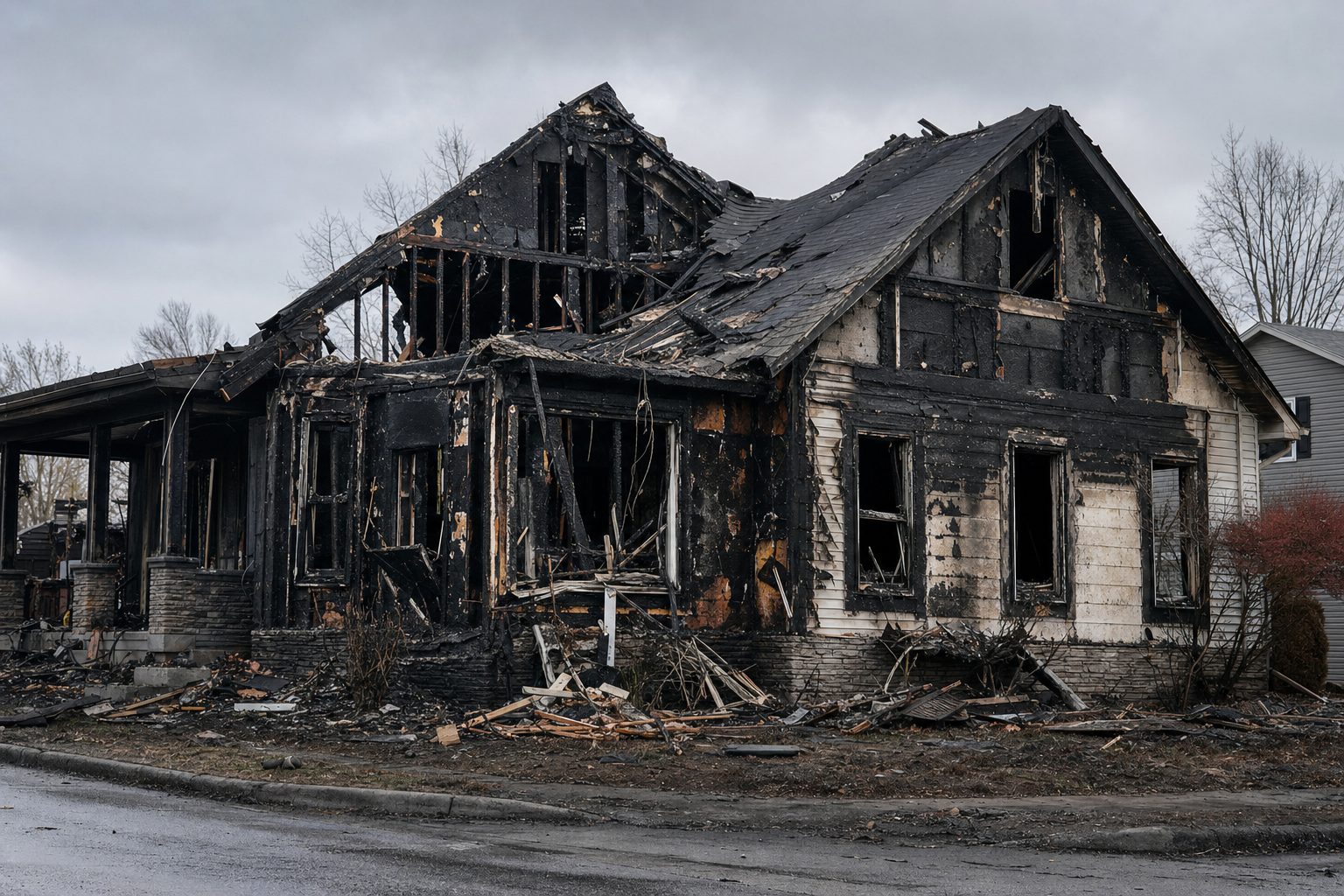
After a house fire, the real cost is not just what burned. Every hour of inaction after a fire adds to the total loss: soot corrosion advances on metals and electronics, permanent staining sets in on walls and ceilings, and water from fire suppression begins its own damage timeline. Early professional response is the single most effective cost-reduction decision a homeowner can make after a fire.
The Fire Is Out. The Clock Has Started.
Smoke corrosion begins within hours. Soot permanently stains porous surfaces within days. Fire suppression water follows the same biological growth timeline as any other water event. And HVAC systems that ran during the fire have already distributed soot particles into every room they serve.
The moment the fire is extinguished, the accumulating cost of waiting begins.
What the Damage Escalation Actually Looks Like
Understanding the timeline from cleaning cost to replacement cost helps clarify why the first 24 hours after a fire matter so much:
Hours one through 24: Soot on most surfaces can still be professionally cleaned. Metals are at the beginning of the corrosion window. Smoke odor has not yet fully penetrated porous building materials. Electronics that are not powered on may still be salvageable.
Days one through three: Permanent staining begins on walls, ceilings, and fabrics not cleaned within this window. HVAC contamination is actively spreading with each system cycle. Soot corrosion on uncoated metals becomes visible. The cleaning cost window begins closing and replacement cost begins opening.
Week one and beyond: Metal fixtures, appliances, and electronics become total losses as corrosion advances. Soot-affected porous materials that were cleanable at day one now require replacement. Every item that crosses from restorable to replaced carries a significantly higher cost.
Each delay converts a cleaning cost into a replacement cost. This pattern is consistent and predictable.
Restoration vs. Replacement: Why the Difference Matters
Professional soot cleaning of a smoke-damaged room uses appropriate agents and techniques per ANSI/IICRC S520 to remove contamination before it becomes permanent. This is a cleaning cost.
Repainting the same room after soot has permanently stained the drywall, replacing furniture that was not cleaned before permanent odor absorption, and replacing HVAC components corroded by unaddressed soot are replacement costs. They are multiples of what early cleaning would have cost.
Ultrasonic cleaning of smoke-affected electronics, applied within the first few days, can recover devices that would otherwise be total losses. The same devices left for two weeks are frequently unrecoverable.
What Professional Restoration Costs Versus What Waiting Costs
We are not in a position to give general estimates for any specific situation, because every project is not the same. What we can say with certainty is this:
We have responded to post-fire situations that appeared catastrophic and became fully restorable because the homeowner called within 24 hours. We have also been called to situations that should have been manageable, that became much larger in scope, because no professional was contacted for a week.
The scope difference between those two outcomes is real and significant.
A Story from Longview: The Kitchen Fire That Did Not Have to Be a Full Loss
A homeowner in Longview had a kitchen fire from a grease ignition that was contained by the fire department before it spread to other rooms. The kitchen itself sustained significant fire and smoke damage. The rest of the house looked intact.
The family called us the same day, while the fire department was still on site. We arrived before the family re-entered the kitchen.
Our assessment found smoke contamination throughout the HVAC ductwork, soot on ceiling surfaces in three adjacent rooms, and protein soot (from the grease fire) coating every surface in the kitchen, including inside cabinets and on appliances. The soot was present but had not yet permanently stained the wall surfaces.
Because we began treatment within hours, the adjacent rooms were cleaned without requiring repainting. The HVAC was cleaned before ongoing redistribution compounded the odor. Several kitchen appliances were saved through appropriate cleaning protocols.
Had the family waited several days before calling, the adjacent room staining would likely have required repainting, and HVAC cleaning would have been more extensive.
How Cantt Restoration Responds to Fire Damage
We assess the full scope of damage per ANSI/IICRC S520 standards, document everything before work begins, and create a restoration plan that saves the maximum possible: structure, contents, and HVAC.
We also address the water damage from fire suppression if present, following ANSI/IICRC S500 protocols for the water component alongside S520 for the fire and smoke component. These are often simultaneous, and they need to be addressed together, not sequentially.
Call Cantt Restoration 24/7
After a fire, call us immediately. The decision to call early is the most effective step you can take.
Cantt Restoration: (903) 251-9525
Sometimes the damage is minimal and you might not need us. We will tell you that too.
This content is for general informational purposes only and does not constitute legal, insurance, or professional restoration advice. Cantt Restoration is not a policy expert, attorney, or public adjuster. Every loss situation is unique. For questions about your coverage, contact your insurance company, adjuster, or agent directly. For assessment of your specific situation, consult a qualified restoration professional. Cantt Restoration follows ANSI/IICRC S500, S520, and S740 standards on every job.
Call Cantt Restoration 24/7
We respond around the clock across East Texas. On-site within the hour.
(903) 251-9525Sometimes the damage is minimal and you might not need us. We will tell you that too.