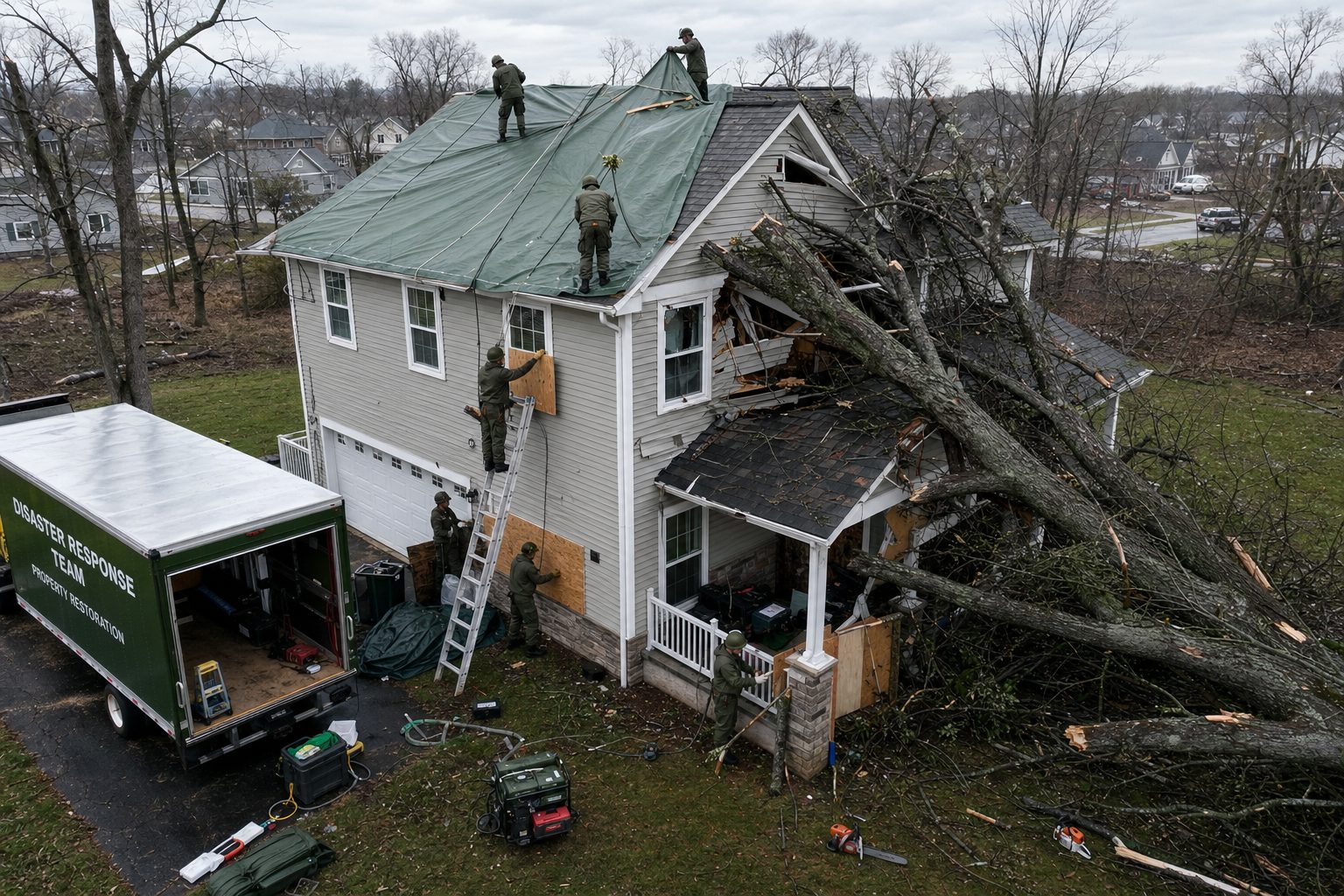
East Texas storms move fast and leave damage that does not wait. Severe thunderstorms, tornadoes, and heavy rainfall cause roof failures, flooding, and structural compromise that worsen by the hour if left unaddressed. Here is what to do when a storm hits your home, and when to call for help.
Storms End. The Damage They Leave Behind Does Not.
Severe weather in East Texas is not a seasonal novelty. Tornadoes, damaging wind events, and heavy rainfall cause real structural damage across Smith, Cherokee, Wood, Gregg, and Harrison counties. A storm that passes through in an hour can leave a home exposed to secondary damage for days if the initial breach is not addressed.
The storm ending does not mean the damage stops. In many ways, the damage escalates after the storm passes.
What Storm Damage Actually Does to a Home
A severe storm event can cause multiple types of damage simultaneously:
Roof damage: Missing shingles, displaced flashing, punctures from hail or debris, and structural compromise to roof decking all allow rain intrusion into the attic and interior spaces. A roof breach that is not tarped within hours turns a roof problem into a whole-home water loss.
Structural compromise: High winds damage load-bearing components, soffits, fascia, and wall sheathing. In severe events, load-bearing damage may not be visible from the exterior.
Storm flooding: Heavy rainfall combined with drainage overwhelm pushes water through doors, windows, and foundation penetrations. Unlike a pipe burst, this is Category 3 water under ANSI/IICRC S500 from the moment it enters the structure.
Tree and debris impact: Fallen trees and wind-driven debris cause immediate structural breaches. Any opening in the structure's exterior envelope must be addressed within hours, not days.
Why Secondary Damage Is Often the Bigger Problem
When a storm breaches a roof, water enters the attic. In East Texas summers, attic temperatures already run extremely high. Add moisture from a storm, and you have conditions favorable for rapid biological growth in addition to structural damage.
A roof breach in a storm means:
- Water saturating attic insulation and pressing it against ceiling drywall from above
- Water migrating down interior wall cavities, following framing paths well beyond the visible wet area
- Ceiling drywall absorbing water weight and potentially failing
What began as a damaged roof becomes a whole-home water loss within 24 to 48 hours without intervention. That is when mold conditions begin developing, per ANSI/IICRC S500 biological growth timelines.
Safety First: Every Time
If a storm has caused structural damage, downed power lines, or any condition you are uncertain about, do not enter the structure. Call 911 and wait for an all-clear from emergency services.
Do what you safely can to limit further damage while you wait. If you do not feel safe, do not go back in. Call us first and we will walk you through it.
A Story from Troup: The Roof Breach Nobody Noticed Immediately
A family in Troup returned home after evacuating for a severe storm warning to find what looked like minimal exterior damage. A section of shingles was missing near the ridge, but the house looked otherwise intact from the driveway. They figured they would call a roofer in the morning.
By morning, the ceiling in the master bedroom had a visible water stain the size of a truck tire. By the time Cantt Restoration arrived, the attic insulation above that bedroom was fully saturated, and moisture had migrated into the wall cavity on the exterior wall.
What would have been a targeted roof repair and a modest attic dry-out became a more involved remediation because of the overnight elapsed time. The visible damage on the exterior was minimal. The damage inside was not.
Cantt Restoration's Storm Response
We respond 24 hours a day, seven days a week across East Texas. Storm response services include:
- Emergency tarping and board-up for storm breaches
- Water extraction and structural drying for interior flooding from storm intrusion
- Complete documentation before any work begins, including moisture mapping with the Extech MO290-RK contractor kit and FLIR thermal imaging
- Pack-out of contents affected by storm-related flooding or structural breach
Storm-related water intrusion follows the same 24 to 72-hour biological growth timeline as any water loss event. Fast response limits the scope significantly.
Call Cantt Restoration 24/7
When a storm damages your home, call us. Every hour matters.
Cantt Restoration: (903) 251-9525
Sometimes the damage is minimal and you might not need us. We will tell you that too.
This content is for general informational purposes only and does not constitute legal, insurance, or professional restoration advice. Cantt Restoration is not a policy expert, attorney, or public adjuster. Every loss situation is unique. For questions about your coverage, contact your insurance company, adjuster, or agent directly. For assessment of your specific situation, consult a qualified restoration professional. Cantt Restoration follows ANSI/IICRC S500, S520, and S740 standards on every job.
Call Cantt Restoration 24/7
We respond around the clock across East Texas. On-site within the hour.
(903) 251-9525Sometimes the damage is minimal and you might not need us. We will tell you that too.