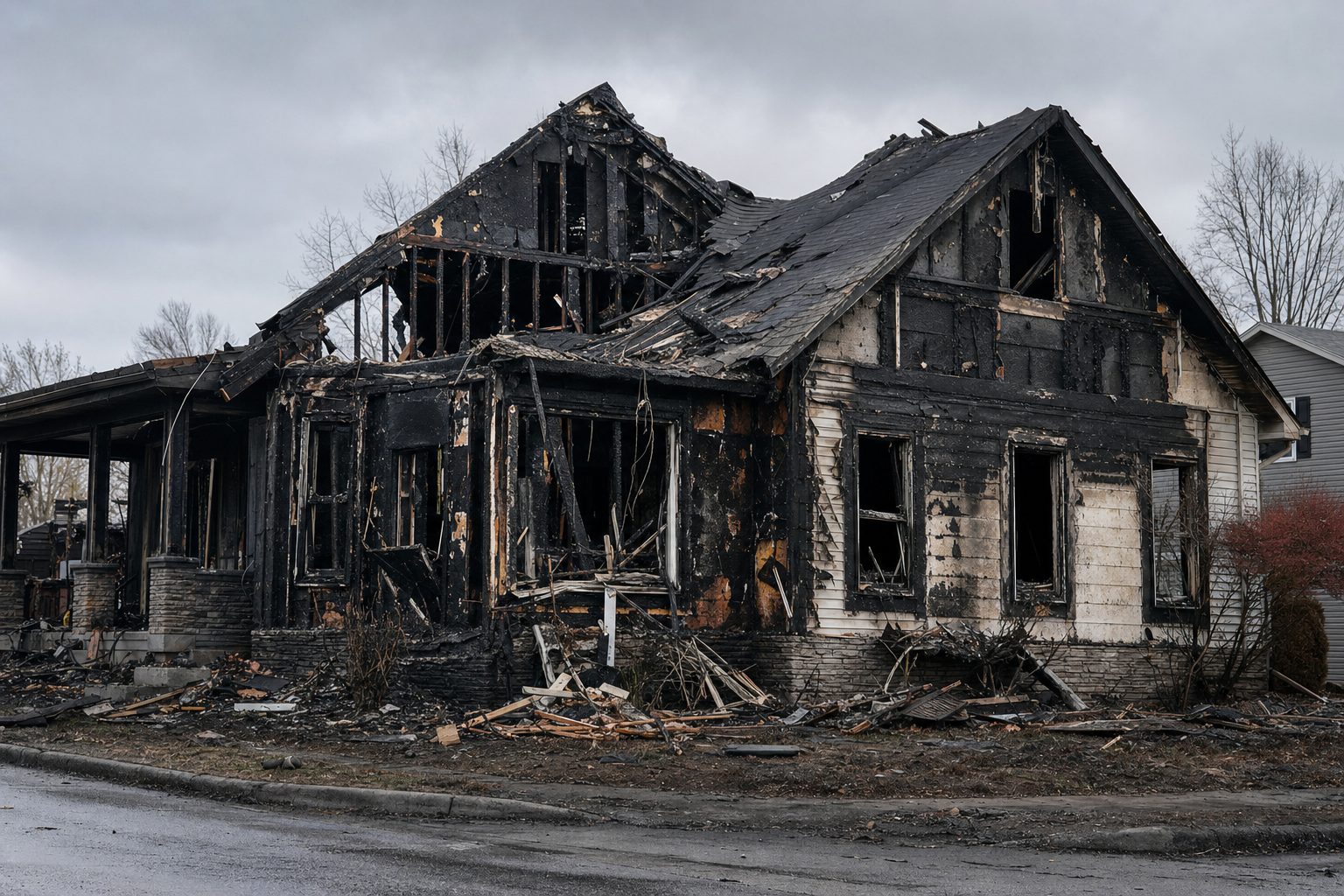
The fire is out. The kitchen is scorched but standing. You can see exactly where it happened, and part of you is already calculating what it will take to clean it up and move on. That is the part that catches most people off guard. A contained kitchen fire is one of the most deceptive losses a home can take. The fire stayed in one place. The smoke did not.
The Fire Stopped. The Damage Did Not.
The moment a fire begins, smoke particles start moving. They are looking for the path of least resistance, and in a modern home, that path runs through the HVAC system. Return air vents pull smoke through ductwork and redistribute it to every room the system serves. By the time the fire is out, soot has already settled on surfaces in rooms that were never touched by a flame.
That is not a worst-case scenario. It is a common one.
What you are smelling from the hallway, the bedroom, the closet is not residual smoke drifting through an open door. It is soot that has already arrived, settled, and begun doing damage on surfaces throughout the home.
What Soot Actually Is
Soot is not dirt. It is the residue of incomplete combustion, a mixture of acidic compounds that react with moisture in the air and begin corroding whatever they land on. According to FEMA's Mitigation Assessment Team guide on residential smoke damage, soot particles measure as small as 0.1 micrometers in diameter, small enough to penetrate deep into porous materials, HVAC components, and electronic devices.
Kitchen fires produce a specific type: protein soot. It comes from burning food and grease. It is nearly invisible on surfaces, has a penetrating odor, and bonds to everything it contacts in a way that most cleaning products cannot address. Standard household cleaners do not remove protein soot. They spread it.
The corrosion clock starts within hours. Chrome, brass, and uncoated metals begin to tarnish. Porous surfaces (walls, ceilings, fabrics) start absorbing soot in a way that leads to permanent staining if they are not reached within the right window. Electronics that were not cleaned promptly often become total losses. The smell, which feels like the main problem, is the last thing on the list.
What the Assessment Finds
When Cantt arrives after a kitchen fire, assessment covers the entire structure, not just the kitchen.
The team uses FLIR thermal imaging cameras, Tramex moisture meters, and temperature guns in combination to read what the building is holding. These instruments do not work alone. No single reading tells the full story. Together, they map where smoke traveled, what surfaces were affected, and what the HVAC system distributed.
Smoke residue testing confirms what assessment tools detect. A white cloth swiped across a surface that appears clean will tell you immediately whether soot has settled there. R&R Magazine's protocol for smoke residue testing describes this as a standard documentation step before any cleaning begins. Black discoloration on the swipe indicates fire-related soot. The sample is labeled, dated, photographed, and logged.
Everything is documented before a single surface is touched. Video first, then photographs. Your adjuster receives a full record of what was found, where it was found, and how it was documented. Smoke and odor migration get documented specifically, not just visible char, because that is where coverage questions arise.
The Scope Is Almost Always Wider Than It Looks
Smoke can travel throughout the structure, including areas with no visible fire damage. What that means in practice after a kitchen fire:
HVAC system. Return air vents pulled smoke through ducts within minutes of the fire starting. Coils, blower components, and ductwork throughout the home may carry soot deposits that will recirculate air contamination until they are properly cleaned.
Adjacent rooms. Any room the HVAC served during the event is a candidate for soot contamination, even if it was closed during the fire.
Soft goods and fabrics. Upholstered furniture, bedding, curtains, and clothing absorb smoke odor at the molecular level. The smell is not on the surface. It is in the material. As R&R Magazine notes on smoke odor remediation, porous materials can off-gas volatile organic compounds for years if they are not properly addressed. Masking odor with a deodorizer does not treat the source. The odor comes back.
Contents. Soot-covered items are addressed with a HEPA vacuum first to remove particulates before any liquid treatment is applied. This is the approach documented by FEMA and the Smithsonian Institution's Heritage Emergency National Task Force: lift the particulate before introducing moisture, because applying liquid to soot drives it deeper and makes it impossible to remove.
The Treatment
Treatment is matched to what each affected area and item actually requires.
Structural surfaces are cleaned using appropriate agents for the soot type. Protein soot from a kitchen fire requires different chemistry than soot from burning synthetic materials. Applying the wrong product to the wrong soot type causes permanent damage.
Odor treatment works in sequence: source removal first, then equipment. Hydroxyl generators run to neutralize odor compounds at the molecular level. Ozone treatment is used in specific applications. Porous surfaces that cannot be cleaned to pre-loss condition may need to be sealed or replaced. The goal is complete odor elimination. We use documented methods to address odor at its source and work toward that goal throughout the job.
Post-restoration evaluation confirms results. Before the job closes, the affected areas are tested by smell under conditions that replicate normal occupancy. The standard, per ANSI/IICRC S700, is the complete absence of detectable fire odors by a person with normal sensitivity. If odor is detected, the process continues.
When the scope of smoke migration or air quality requires a higher level of technical assessment, Cantt brings in industrial hygienists and third-party specialists. Knowing when to call in the right expert is part of the job.
What "Livable" Actually Means
Every project is not the same. Every definition is relative.
For a healthy adult, a kitchen fire with smoke migration to two rooms might mean the rest of the house is usable within days of remediation. For someone with COPD or respiratory sensitivity, the same job looks completely different. The same residual VOC level. The same air quality reading. Two people in two completely different situations.
When walls are open and conditions warrant it, Cantt's air quality work is matched to the occupants of that home, not to a universal checklist. The goal is a home that is genuinely safe for the people who live in it. What that requires depends on who those people are.
If you have a household member with a respiratory condition, a compromised immune system, or a chemical sensitivity, tell us at the first call. That context shapes how the job is scoped, how the air quality standard is defined, and how the project closes.
What the Camera Cannot Capture
Documentation is a specialized skill. Photography captures what is visible. Matterport scans the structure. Neither one can record smell.
In a room with no visible fire damage, the assessment team reads surfaces, equipment instruments, and air conditions together. If you are standing in a bedroom that was nowhere near the kitchen fire and the room carries a smoke odor, that odor represents soot particulates that have already settled there. A photograph does not convey that. A Tramex moisture reading does not convey that either. The documentation records the data. The job of the assessment team is to walk through that record with your adjuster so they understand what the instruments found and what the instruments cannot represent on their own.
That conversation between contractor and adjuster matters. Numbers on a page are documentation. Understanding what those numbers mean in a room that still smells like a fire is the work.
What Cantt Will Not Document
We document what is actually there. Not more. Not less.
Cantt does not manufacture scope. Every item documented as smoke-affected is genuinely smoke-affected. Every reading logged is an actual reading. We will not climb on top of an appliance, show dust, and call it soot. We have been on the other side of that table. We have seen it happen. We will not do it.
This matters for you because your claim rests on what is actually documented. Inflated documentation creates disputes. Disputes delay your project. Accurate, complete, honest documentation gives your adjuster a clean record to work from and gives your project the best chance of moving efficiently.
The record Cantt builds is defensible because every line of it is true.
While You Wait for Us
Do what you safely can to limit further damage while you wait. If you do not feel safe, do not go back in. Call us first and we will walk you through it.
Reasonable mitigation before we arrive is appropriate and encouraged. Open windows for ventilation if the structure is safe to enter. Move undamaged items away from any standing water. Blot surface moisture if you have access. What we ask you not to do is attempt to clean soot surfaces with household products. Protein soot from a kitchen fire spreads when you wipe it with a standard cleaner. You can cause permanent staining on surfaces that were still treatable. Leave the soot alone. Let us document it first.
You are not obligated to stand by and watch your home get worse while you wait. You are also not expected to fix a specialized contamination problem without specialized tools. The line between those two things is safety and honesty with yourself about what you are equipped to handle.
On the Contents
The kitchen is structural damage. Everything that smoke reached is a contents question. They run at the same time.
Cantt's contents team assesses all affected items: electronics, clothing, soft goods, documents, anything in the path of smoke migration. Items that can be restored go through the appropriate process at Cantt's climate-controlled facility. Items that cannot be restored are documented thoroughly so your adjuster has what is needed to evaluate replacement cost. Nothing is declared a total loss without a documented reason behind it.
We assess all contents using industry protocols. Some can be restored. Some cannot. Either way, your adjuster receives a complete record.
Call Cantt Restoration 24/7
Cantt Restoration serves Tyler, Arp, and East Texas with 24/7 emergency response. Call any time. Our experienced staff will come out, assess the full scope of what the fire left behind, and walk you through exactly what can be done.
Cantt Restoration: (903) 251-9525
Sometimes the damage is less than the smell suggests. Sometimes it is more. We will tell you the truth either way.
This content is for general informational purposes only and does not constitute legal, insurance, or professional restoration advice. Cantt Restoration is not a policy expert, attorney, or public adjuster. Every loss situation is unique. For questions about your coverage, contact your insurance company, adjuster, or agent directly. For assessment of your specific situation, consult a qualified restoration professional. Cantt Restoration follows ANSI/IICRC S500, S520, and S740 standards on every job.
Call Cantt Restoration 24/7
We respond around the clock across East Texas. On-site within the hour.
(903) 251-9525Sometimes the damage is less than the smell suggests. Sometimes it is more. We will tell you the truth either way.
Sometimes the damage is minimal and you might not need us. We will tell you that too.