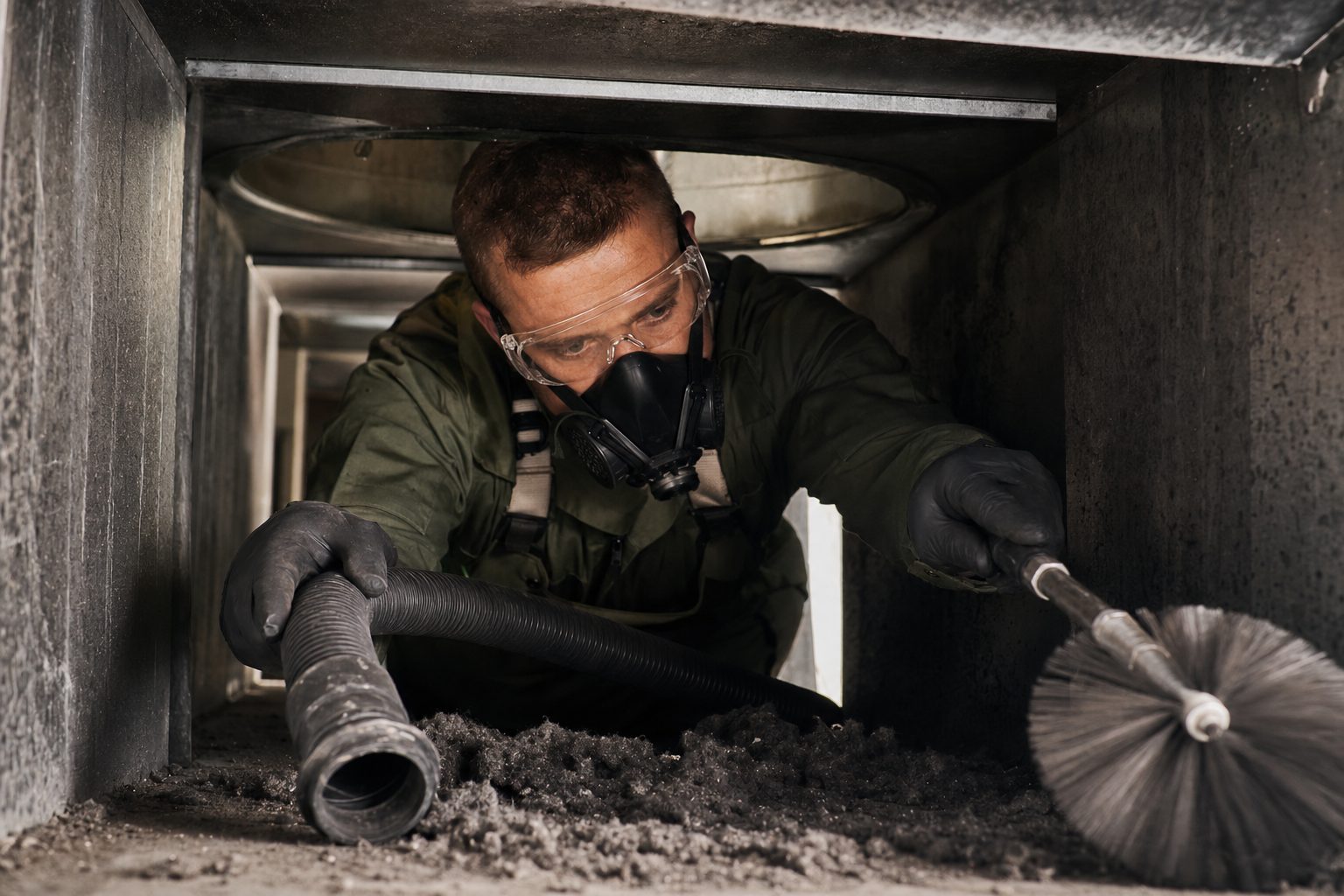
After a house fire in East Texas, the HVAC system may continue running with air filters completely saturated with soot. Every operating cycle pushes soot-laden air through the system, past the evaporator coils, and through every room of the home. The first action after any fire event is to turn off the HVAC system completely. Not turn it down. Turn it off. This post explains what happens to air filters during a fire and why it matters for the full scope of post-fire restoration.
What Happens to HVAC Air Filters During a Fire?
Air filters capture particles from the air flowing through the return system. During a fire, the concentration of soot particles in the home air is orders of magnitude higher than normal operating conditions. This overwhelms any filter's designed capacity rapidly. A MERV-13 filter captures a high percentage of particles in normal operation, but it reaches saturation quickly under fire-smoke conditions.
Once a filter saturates, three things happen simultaneously. The filter loses particle capture efficiency because the media is full. Pressure drop across the saturated filter increases, stressing the blower motor. And soot that the saturated filter cannot capture bypasses it and reaches the evaporator coil directly.
Why Does Soot That Bypasses the Filter Matter So Much?
Soot that reaches the evaporator coil deposits on the copper tubing and aluminum fins and initiates an acidic corrosion reaction. As covered in our post on HVAC coil damage, this corrosion can begin to pit and fail coil fins within days. The more soot that bypasses the filter, the more contamination reaches the coil, and the more urgent post-fire coil cleaning becomes.
A filter that saturates quickly during a fire is not a filter failure. It is the filter doing its job under conditions it was never designed to handle. The solution is to turn off the system the moment a fire is confirmed, preventing further soot loading of both the filter and the coil.
Are Removed Filters Evidence?
Yes. The condition of removed filters documents the extent of HVAC contamination. A visually saturated, soot-blackened filter is physical evidence of the contamination event. Industry practice is to document and retain removed filters as part of the loss record. We photograph and document filter condition as part of our post-fire HVAC assessment. These filters belong in the documentation package.
What Are the Correct Steps for HVAC After a Fire?
The sequence matters. First: turn off the HVAC system the moment the fire is confirmed or the system has been running during the event. Second: do not restart the system for any reason until the full post-fire HVAC assessment and cleaning are complete. Third: when the assessment is complete and professional cleaning of the coil and ductwork is done, replace all filters before restarting the system. New filters in a contaminated system are the last step, not the first.
Running the HVAC after a fire, even briefly, to try to clear smoke odor is the most common mistake we see in post-fire situations. It distributes contamination to every room that was not directly affected by the fire, accelerates coil corrosion, and extends the overall restoration timeline.
A Scenario From Cuney
A property in Cuney had a fire in an attached garage that sent significant smoke into the adjacent living area through an HVAC return located in the hallway. The occupants turned on the HVAC to push the smoke out and ventilate the home before Cantt Restoration arrived. By the time we assessed the system, the filter was visibly saturated with black soot, and thermal imaging showed soot deposits on the evaporator coil.
We documented the filter condition, photographed the coil deposits, and coordinated professional coil and duct cleaning before the system was cleared for operation. The two hours the system ran after the fire added scope to the post-fire HVAC remediation that would not have existed otherwise.
Cantt Restoration Addresses the Full HVAC System
Post-fire HVAC evaluation, filter condition documentation, and coordination of complete system cleaning are standard components of our fire loss assessment, not optional additions. We do not restore the structure and leave the HVAC system contaminated. The system distributes air to every space in the home. Leaving it contaminated means leaving the restoration incomplete.
Call Cantt Restoration 24/7
(903) 251-9525Sometimes the damage is minimal and you might not need us. We will tell you that too.
Send Us a Photo for a Free Assessment
Not sure how bad the damage is? Send a photo and we will give you an honest assessment. No sales pitch. No pressure.
Send a Photo- One or two clear photos of the affected area is plenty
- No need to include people, faces, or personal documents
- Photos of walls, floors, ceilings, or contents are most useful
Photos submitted are used solely to assess your situation. They are not shared, sold, or published without your written consent. You may also email photos directly to contact@canttrestoration.com.
Cantt Restoration serves all of East Texas, Smith County, Cherokee County, Wood County, Gregg County, and beyond. Based in Arp, TX. Call (903) 251-9525.
This content is for general informational purposes only and does not constitute legal, insurance, or professional restoration advice. Cantt Restoration is not a policy expert, attorney, or public adjuster. Every loss situation is unique. For questions about your coverage, contact your insurance company, adjuster, or agent directly. For assessment of your specific situation, consult a qualified restoration professional. Cantt Restoration follows ANSI/IICRC S500, S520, and S740 standards on every job.
Frequently Asked Questions
What should I do with my HVAC system after a house fire?
Turn off the HVAC system immediately. Do not run it to clear smoke or ventilate the home. Filters saturated with soot continue distributing contamination every cycle, and soot that bypasses a saturated filter deposits on the evaporator coil and initiates corrosion. The system should remain off until the full post-fire assessment and professional cleaning are complete.
Do I need to replace HVAC filters after a fire?
Yes. All filters should be replaced before restarting the HVAC system after a fire, but only after the full post-fire coil and duct cleaning is completed. New filters installed before coil and duct cleaning are in a contaminated system and provide false assurance. Document the condition of removed filters as evidence of system contamination.
Can running the HVAC after a fire make the damage worse?
Yes. Running the HVAC after a fire distributes soot-laden air throughout the home, accelerates evaporator coil corrosion as soot bypasses the saturated filter, and spreads smoke odor to rooms not directly affected by the fire. Brief operation after a fire can significantly increase the scope of post-fire remediation.
How quickly do HVAC filters saturate with soot during a fire?
Soot particle concentration during a fire is orders of magnitude higher than normal operating conditions. Even high-rated filters like MERV-13 reach saturation rapidly under fire-smoke conditions. Filter saturation can occur within minutes during an active fire or shortly after a fire while the home still has elevated smoke particle levels.
What does Cantt Restoration include in post-fire HVAC assessment?
We evaluate and document filter condition with photographs, assess return ductwork for soot deposition, inspect the evaporator coil for soot contamination and early corrosion indicators, and coordinate professional cleaning of the full system including coil, ductwork, and all supply and return vents before clearing the system for operation. HVAC assessment is included in every fire loss evaluation.