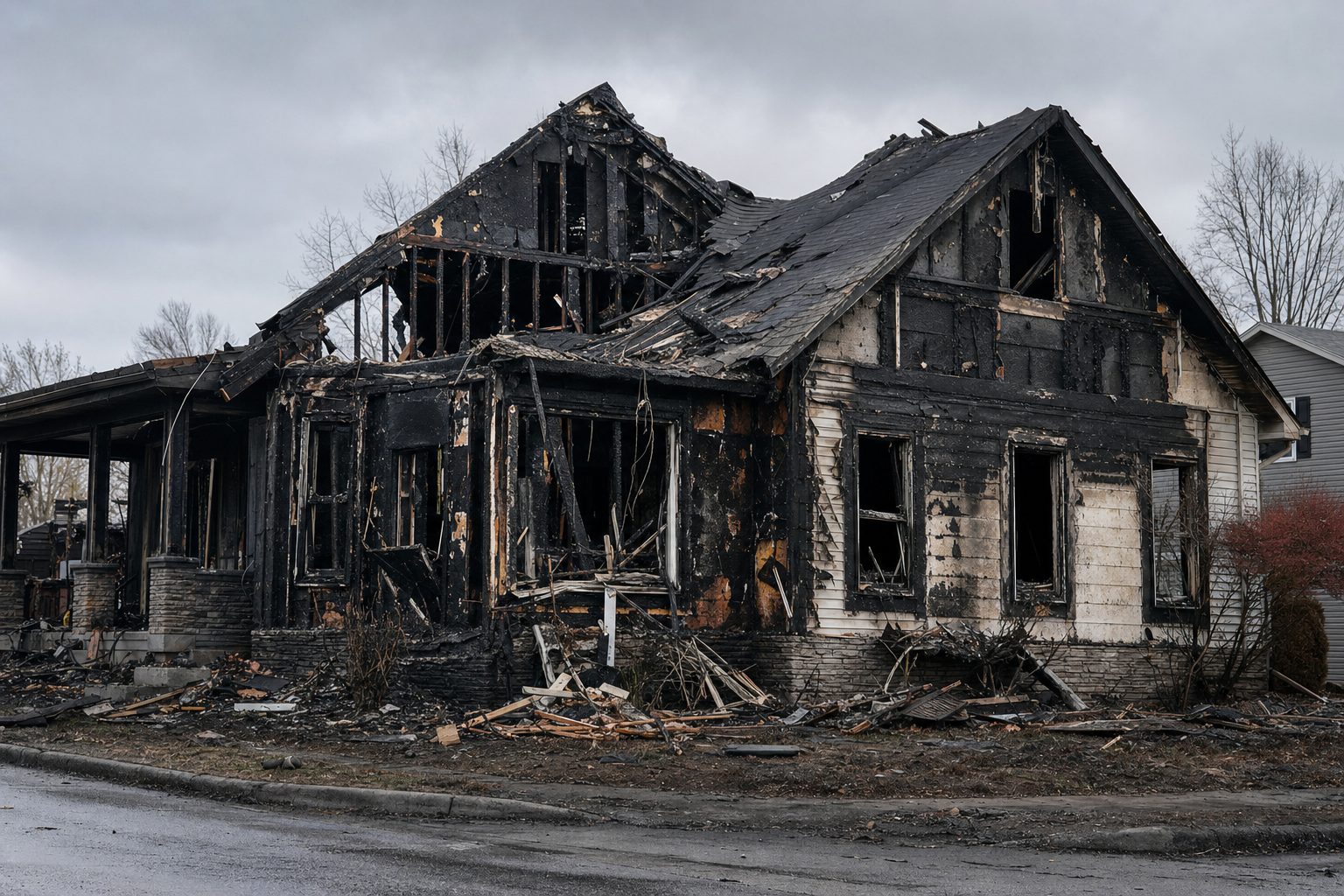
After a house fire, documentation is the last thing on most homeowners' minds. It should be the first. A complete, timestamped record of your loss, created before any work begins, is the foundation that protects your interests throughout the entire restoration process and beyond.
What Does "Documentation First" Mean in Fire Damage Restoration?
It means no work begins until the full scope of the loss is captured in a permanent record. Before any cleaning, before any demolition, before any contents are moved, Cantt Restoration documents. We use Matterport 3D scanning to capture every affected space in navigable, measurable 3D. We photograph every damaged surface. We use FLIR thermal imaging to identify smoke migration and heat damage in wall cavities that visual inspection cannot see. We inventory every affected item with location, condition, and photograph. We document what is actually there. Not more. Not less.
What Does a Complete Fire Damage Documentation Record Include?
Pre-Work 3D and Photographic Documentation
Matterport 3D scanning captures the spatial story of the fire: where burn damage is concentrated, how smoke migrated through the home, how structural damage relates to fire origin and spread. A fire scene is three-dimensional. A photograph captures a moment. Matterport captures the full environment in a model that can be navigated, measured, and reviewed from any angle months or years later. High-resolution photography of every affected surface supplements the 3D model with close-up detail.
Soot and Smoke Mapping
Fire produces different types of soot depending on what burned. Dry soot from fast-moving fires, wet soot from slow smoldering fires, and protein soot from kitchen fires each require different cleaning approaches. Documenting soot type and distribution is not just a paper exercise. It determines the entire cleaning protocol. Thermal imaging identifies smoke migration pathways inside wall cavities and HVAC ductwork.
Structural Damage Assessment
Every structural member in the affected area is assessed and documented. Fire-weakened or charred framing is noted with location and extent. Engineered lumber exposed to fire is treated with particular care, as engineered lumber can fail without the same visible charring cues as dimensional lumber.
Contents Inventory
Every affected item in the structure is inventoried before anything leaves the property. Location, condition, category, and a photograph for every item. Items that are not documented before removal have no record in the loss.
An East Texas Story: A Lindale Home and the Garage Fire That Spread
A Lindale family had a garage fire that spread into the living space through the shared wall before it was extinguished. Before any work began, Cantt Restoration completed a full Matterport scan of both spaces, thermal imaging of all shared walls and the HVAC system, and a complete contents inventory of the affected rooms. Thermal imaging revealed that smoke had migrated through the top plate of the shared wall into the attic space above the living room. That attic area required remediation that would not have been identified without thermal imaging. The documentation was complete before the first cleaning cloth was used.
Why Matterport Documentation Is Different for Fire Losses
Matterport preserves the spatial story of the fire permanently. That 3D model can be revisited, measured, and reviewed from any angle, long after the site has been restored. When questions arose about the extent of the original damage in the Lindale home, the Matterport model and thermal imaging reports provided definitive answers.
Call Cantt Restoration 24/7
(903) 251-9525Sometimes the damage is minimal and you might not need us. We will tell you that too.
Send Us a Photo for a Free Assessment
Not sure how bad the damage is? Send a photo and we will give you an honest assessment. No sales pitch. No pressure.
Send a Photo- One or two clear photos of the affected area is plenty
- No need to include people, faces, or personal documents
- Photos of walls, floors, ceilings, or contents are most useful
Photos submitted are used solely to assess your situation. They are not shared, sold, or published without your written consent. You may also email photos directly to contact@canttrestoration.com.
Cantt Restoration serves all of East Texas , Smith County, Cherokee County, Wood County, Gregg County, and beyond. Based in Arp, TX. Call (903) 251-9525.
This content is for general informational purposes only and does not constitute legal, insurance, or professional restoration advice. Cantt Restoration is not a policy expert, attorney, or public adjuster. Every loss situation is unique. For questions about your coverage, contact your insurance company, adjuster, or agent directly. For assessment of your specific situation, consult a qualified restoration professional. Cantt Restoration follows ANSI/IICRC S500, S520, and S740 standards on every job.
Frequently Asked Questions
Why is documentation the first step in fire damage restoration?
A complete fire damage record captures the full scope of structural damage, smoke migration, soot patterns, and affected contents before any work begins. Once cleaning or demolition starts, the original damage condition is permanently altered. Documentation is only possible before the first work is done.
What does Matterport 3D scanning capture after a house fire?
Matterport captures a navigable, measurable 3D model of every affected space in its damaged condition, including burn patterns, structural damage locations, soot migration paths, and the spatial relationship between all affected areas. The spatial context it preserves cannot be replicated by standard photography.
Why does soot type matter in fire damage documentation?
Different soot types require different cleaning approaches. Dry soot from fast fires, wet soot from slow smoldering fires, and protein soot from kitchen fires each respond to different cleaning agents and methods. Documenting soot type before cleaning begins is part of developing the correct restoration protocol.
What happens to structural documentation when a restoration company skips the pre-work scan?
Without pre-work documentation, there is no permanent record of the original damage condition. The scope of structural damage, smoke migration, and contents condition must be reconstructed after the fact, creating ambiguity that thorough pre-work documentation eliminates entirely.
How long does fire damage documentation take before work begins?
A thorough documentation of a residential fire loss typically takes several hours. For larger homes or more extensive losses, it may take longer. This time is the foundation that supports everything that follows in the restoration process.