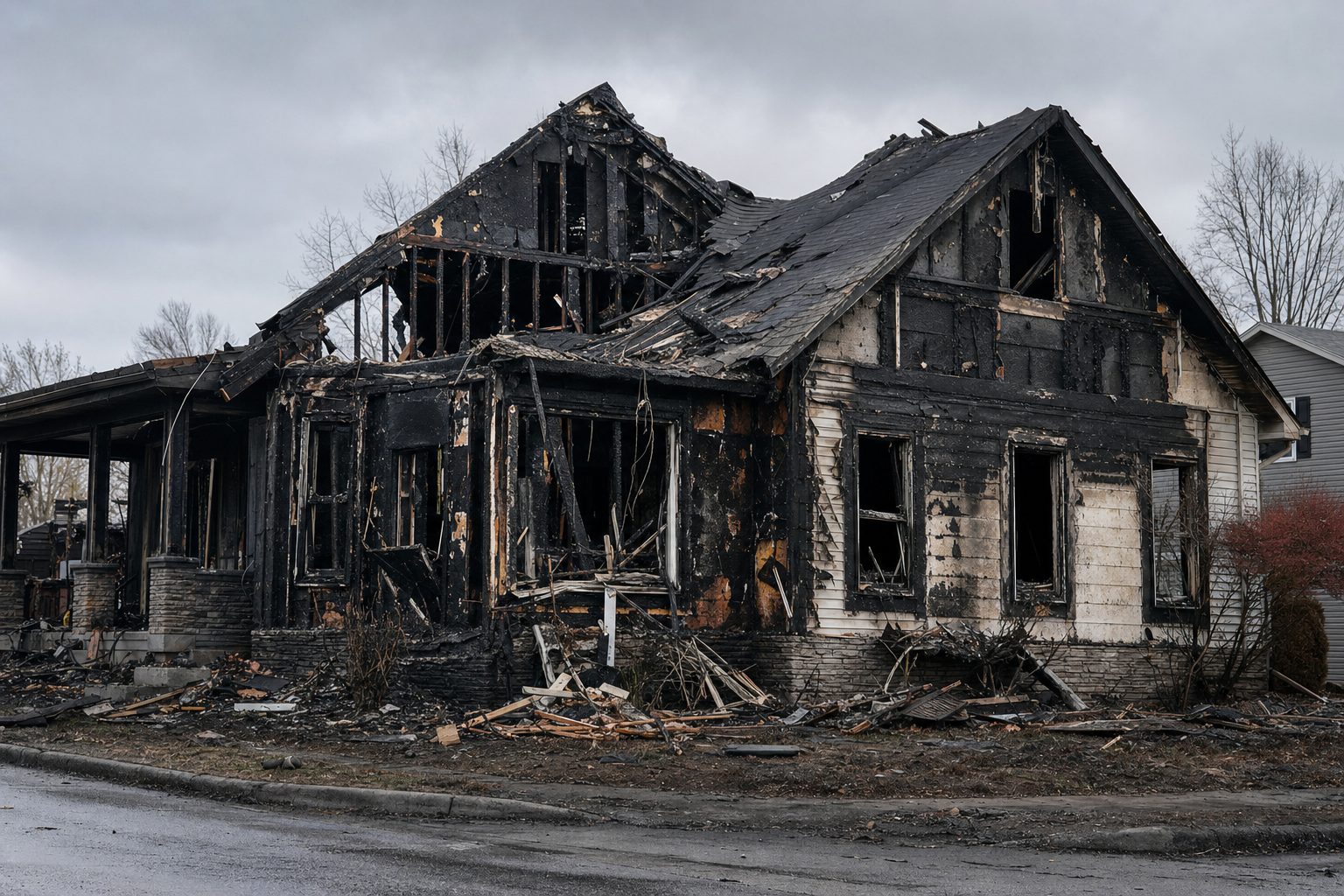
The decisions made in the first 24 hours after a house fire determine how much of the home and its contents can be saved. Most homeowners have never been through a house fire before and have no frame of reference for what to do. This guide provides it.
Is It Safe to Re-Enter After a Fire?
Do not re-enter your home after a fire until the fire department has declared the structure safe for entry. This is not a recommendation. It is a safety requirement.
Post-fire structures present multiple hazards that are not visible to the untrained eye: structurally compromised framing and floors, electrical systems that may still be energized, residual combustion products in the air, and instability in burned sections of the structure. The fire department's clearance is the entry standard.
What Should I Do in the First Hour After a Fire?
- Call 911 if you have not already and ensure everyone is accounted for and safe
- Stay at a safe distance until the fire department arrives and controls the scene
- Contact family members who may need to know what has happened
- Call Cantt Restoration: (903) 251-9525 for emergency response: we can coordinate with the fire department and be ready to respond the moment the structure is cleared
What Happens When Cantt Restoration Arrives?
Our first action is documentation, not cleaning. Before anything is touched, before any contents are moved, the complete loss is recorded:
- Matterport 3D scanning of all affected areas in their original damaged condition
- High-resolution photography of all structural damage, soot patterns, and affected contents
- FLIR thermal imaging to identify heat and smoke migration in wall cavities and the HVAC system
- Contents inventory of every affected item with location and condition noted
We document what is actually there. Not more. Not less.
What Should I Avoid in the First 24 Hours?
- Do not turn on the HVAC system. Post-fire HVAC systems redistribute soot to every room, including rooms that were not fire-affected.
- Do not wipe soot from surfaces. Wiping dry soot spreads and sets contamination. Professional dry-cleaning sponge technique must come first.
- Do not use water to clean soot. Water applied to dry soot spreads and permanently sets it into porous surfaces.
- Do not discard anything before documentation. Items that have been discarded before documentation have no record in the loss.
- Do not let children or pets enter until professional assessment confirms it is appropriate.
An East Texas Story: A Tyler Family and the First Calls After a Kitchen Fire
A Tyler family had a kitchen fire that spread to the adjacent dining room before being extinguished. Within 30 minutes of the fire department clearing the scene, the homeowner had called Cantt Restoration and, following our guidance by phone, had turned off the HVAC system from the exterior thermostat and resisted the urge to wipe the soot from the kitchen counter surfaces.
Our team arrived within the hour. The documentation process took approximately two hours before work began. When we addressed the dining room walls, we found that the soot pattern on one wall indicated smoke had migrated into the adjacent bedroom through the top plate. Thermal imaging confirmed smoke infiltration in the bedroom wall cavity.
That bedroom discovery was only possible because nothing had been wiped or cleaned before our arrival. The documentation was complete. The scope was accurate. The restoration was complete.
The FEMA Guidance on Post-Fire Safety
The FEMA After Fire guide provides additional guidance on safety, documentation, and initial steps for homeowners following a fire loss. We recommend reviewing this resource alongside working with a professional restoration company.
Call Cantt Restoration 24/7
(903) 251-9525Sometimes the damage is minimal and you might not need us. We will tell you that too.
Send Us a Photo for a Free Assessment
Not sure how bad the damage is? Send a photo and we will give you an honest assessment. No sales pitch. No pressure.
Send a Photo- One or two clear photos of the affected area is plenty
- No need to include people, faces, or personal documents
- Photos of walls, floors, ceilings, or contents are most useful
Photos submitted are used solely to assess your situation. They are not shared, sold, or published without your written consent. You may also email photos directly to contact@canttrestoration.com.
Cantt Restoration serves all of East Texas , Smith County, Cherokee County, Wood County, Gregg County, and beyond. Based in Arp, TX. Call (903) 251-9525.
This content is for general informational purposes only and does not constitute legal, insurance, or professional restoration advice. Cantt Restoration is not a policy expert, attorney, or public adjuster. Every loss situation is unique. For questions about your coverage, contact your insurance company, adjuster, or agent directly. For assessment of your specific situation, consult a qualified restoration professional. Cantt Restoration follows ANSI/IICRC S500, S520, and S740 standards on every job.
Frequently Asked Questions
When can I re-enter my home after a house fire?
Only after the fire department has officially declared the structure safe for entry. Post-fire structures may have compromised structural elements, active electrical hazards, and residual combustion products in the air. Do not assume re-entry is safe without explicit clearance from the fire department.
Should I turn on my HVAC after a fire to air out the smoke?
No. Turning on the HVAC system after a fire redistributes soot-laden air to every room the system serves, including rooms that were unaffected by the fire. The system should remain off until it has been professionally inspected and, if needed, cleaned. This prevents secondary soot contamination throughout the home.
What if I already wiped some soot before the restoration company arrived?
Tell the restoration team what you wiped and where. Wet-wiping dry soot spreads it and sets it permanently into porous surfaces. If surfaces were wiped before professional arrival, the affected areas are documented in their current state, and additional treatment steps may be required.
How do I know if my home is structurally safe to enter after a fire?
Only a fire department official or structural engineer can make that determination. Signs of potential structural concern include visible charring on load-bearing walls or floors, sagging ceilings, warped door frames, and areas where fire burned through the structural assembly. Do not assess structural safety by visual inspection alone.
Do I need to document the damage myself before calling restoration?
You do not need to do anything before calling. Cantt Restoration performs complete documentation before any work begins. If you choose to take photographs before we arrive, do so without disturbing any materials. A video walkthrough of the scene, without touching anything, is the best approach if you have time before we arrive.