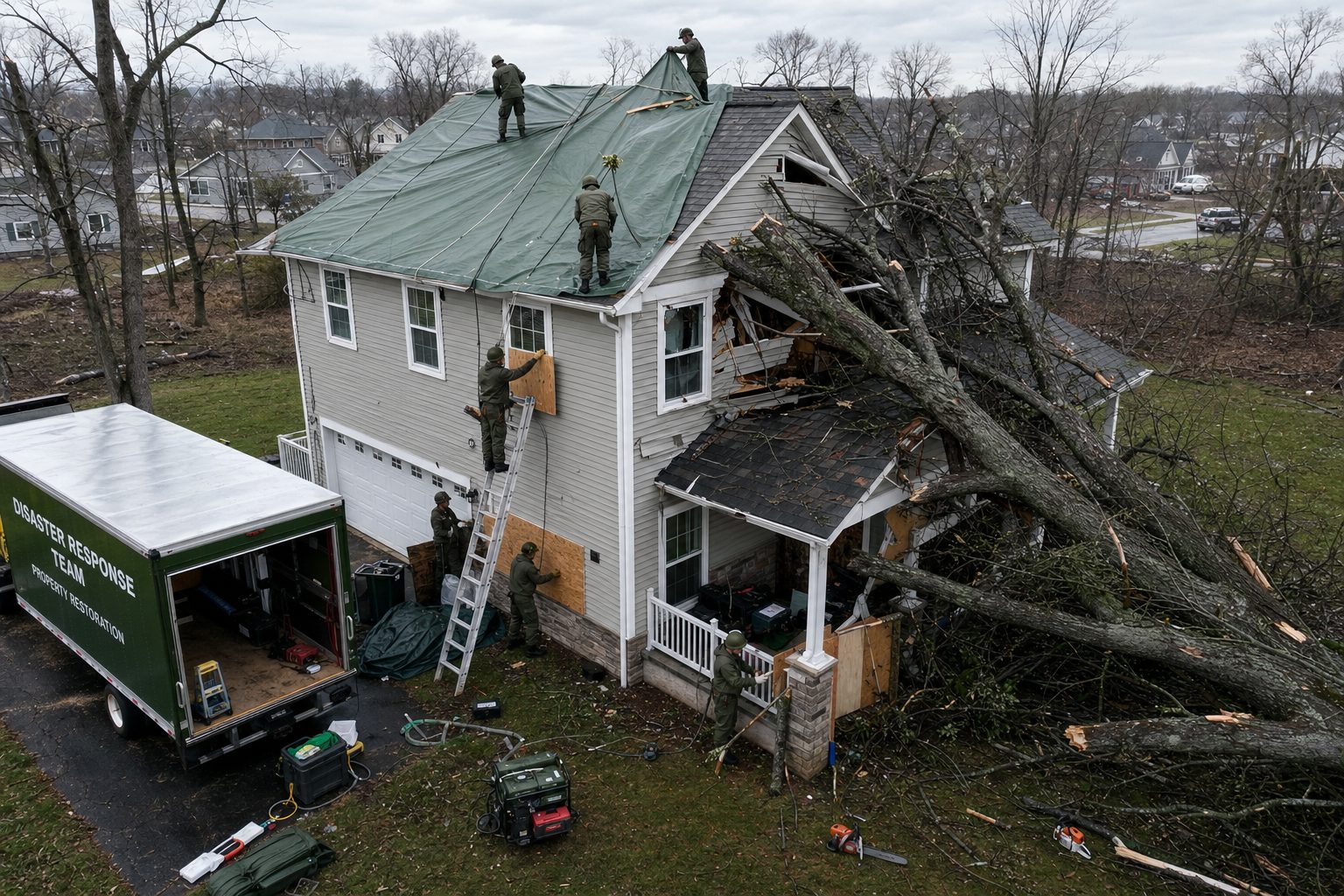
A large pine or oak comes down in East Texas and the sound alone is enough to stop your heart. When the tree lands on your roof, the next few hours matter more than most people realize. Water enters immediately. The clock on mold starts within 24 to 72 hours. And the documentation you create in those first moments shapes everything that comes after. This post walks through exactly what to do, in order, without panic.
Step One: People First, Always
Before anything else, account for every person in the house. If anyone is injured, trapped, or if the structure looks seriously compromised, call 911 immediately. Do not go back inside a home where the roof or walls appear to be in danger of secondary collapse. A ceiling that absorbed the full weight of a tree can shift further without warning.
If the power is still on and the tree has made contact with electrical lines or interior wiring, treat the situation as a potential hazard and stay out until the utility company clears it. Call your utility provider before you call anyone else if you see downed lines.
Once you know everyone is safe and the structure appears stable enough to enter carefully, then you can begin the next steps. Do what you safely can to limit further damage while you wait. If you do not feel safe, do not go back in. Call us first and we will walk you through it.
What Actually Happens When a Tree Hits Your House
People often picture a tree fall as a single dramatic event. The reality is that it creates several problems at once, and they interact with each other quickly.
The Roof Breach
The moment a tree penetrates the roofline, the building envelope is open. Rain does not have to be falling right now for that to matter. East Texas weather turns fast. What is clear at noon can bring a hard storm by late afternoon. An open roof in this climate is an open invitation for water intrusion, and every hour that breach remains unaddressed is an hour water has to reach the structure below.
Structural Load Shift
Roof systems are engineered to carry specific loads. A mature tree, particularly the pine and hardwoods common throughout Smith, Cherokee, and Wood counties, can weigh several tons. When that load transfers to a roofline it was never designed to carry, the forces redistribute across rafters, trusses, and ceiling joists in unpredictable ways. Areas that appear undamaged from below may be carrying stress they should not. This is one reason a structural inspection by a qualified contractor or engineer matters before heavy equipment or people spend extended time inside the affected rooms.
Immediate Water Intrusion
Even a brief rain event through an open roof breach can saturate insulation, framing, ceiling drywall, and flooring below. Water follows the path of least resistance. It travels down rafter lines, pools in ceiling cavities, then saturates drywall and drops into the living space below. What looks like a contained ceiling stain often represents saturation that has traveled four or five feet beyond the visible damage.
The First 72 Hours and Why They Define Everything
In restoration, the 72-hour window after a water intrusion event is the period when early action makes the most difference. Wet building materials and elevated humidity create the conditions mold (what restoration professionals classify as microbial growth) needs to establish itself. According to CDC guidance on mold, mold can begin to grow on wet surfaces within 24 to 48 hours under the right conditions.
East Texas humidity accelerates that timeline. The combination of warm temperatures, naturally high ambient moisture, and a roof open to outside air creates an environment where microbial growth can take hold faster than homeowners typically expect. The same conditions that make this region beautiful to live in also make unmitigated water damage a more urgent problem here than in drier climates.
Within those 72 hours, the priorities are: get the breach secured against further rain intrusion, document everything before anything is moved, begin extracting standing water if present, and get professional moisture assessment tools into the structure. Every hour of delay compresses the window for effective mitigation.
A Story from Brownsboro: The Rain Came the Next Morning
A family in Brownsboro lost a large pine across their back porch and into a corner bedroom during a line of storms that moved through Henderson County overnight. The tree missed the main roofline and the family decided, understandably, to wait until daylight to assess things. The structural damage looked limited to the corner. The room was messy but intact.
What they could not see in the dark was that the impact had cracked the flashing where the porch roof tied into the main structure. A second round of storms came through the next morning. The cracked flashing channeled water directly into the wall cavity between the bedroom and the hallway. By the time we arrived, the moisture had traveled through insulation and was beginning to wick up the drywall on the interior hallway wall, a wall no one had thought to check.
The Extech MO290-RK moisture assessment kit and FLIR thermal imaging found saturation in three wall cavities the visual inspection had not flagged. The documentation from the Matterport 3D scan we completed before any work began created a spatial record of the moisture extent as it actually existed, not as anyone remembered it afterward. That record mattered.
Document Before You Move Anything
Before you lift a single piece of debris or move a single item of furniture, document what you see. Video first, then photos. Walk through the space with your phone running video. Narrate what you observe: where the tree entered, what rooms are visible from the breach, which surfaces show damage, where you see wet flooring, saturated ceiling material, or displaced belongings.
Video gives a continuous spatial record that a folder of photographs cannot replicate. After the video, photograph specific areas of concern from multiple angles. These records belong to you. They document what was actually there at the time of loss, not a reconstructed version of it.
Cantt Restoration uses Matterport 3D scanning to create a complete, navigable digital model of the loss before any restoration work begins. That model captures spatial relationships, room dimensions, damage extent, and the location of personal property in a way that flat photographs cannot. We document what is actually there. Not more. Not less.
After you have documented the scene, contact your insurance adjuster or your agent to report the loss. We do not advise on what your policy covers or how to approach your claim. Those are conversations for you and your adjuster or agent directly. What we can tell you is that thorough early documentation supports every subsequent step in the process.
What Cantt Restoration Does After a Tree Fall
Cantt Restoration is a mitigation, remediation, and contents specialist. We are not a general contracting firm. Emergency tarping and structural boarding are typically handled by a general contractor or roofing company before we arrive. Once the breach is secured against further intrusion, Cantt steps in to handle the water and what it has done to your home.
Water Mitigation from Rain Intrusion
We assess moisture extent using thermal imaging and calibrated moisture meters across every affected surface, including areas that do not look wet to the eye. We extract standing water, remove saturated materials that cannot be dried in place, and deploy Dri-Eaz drying equipment to bring affected structural materials back within acceptable moisture content ranges. All work follows ANSI/IICRC S500 standards.
Mold Assessment and Remediation
If water from the breach has been present for more than 24 hours, or if conditions in the affected area are favorable to microbial growth, we assess for mold. When walls are open and conditions warrant it, we apply Bioesque botanical disinfectant solution as part of the remediation process. Mold remediation at Cantt follows ANSI/IICRC S520 standards.
According to EPA guidance on mold remediation, the key to controlling mold is controlling moisture. In a tree-fall scenario, that means addressing the water intrusion pathway completely before any surface treatment has lasting effect. We do not treat the surface and move on. We find where the water went.
Contents Assessment, Pack-Out, and Storage
This is where many homeowners are caught off guard. When rain enters through a roof breach, it does not stop at the structural materials. It reaches flooring, furniture, clothing, documents, electronics, family photographs, and everything else stored in or near the affected rooms. These items are not gone simply because they got wet.
Cantt Restoration assesses, documents, packs out, cleans, and stores personal property affected by water intrusion events. We work through the contents systematically, item by item. Nothing disappears. Everything is documented before it leaves your home. The record of where each item was located, its condition at the time of removal, and its treatment and storage status stays with the file.
We treat the property in our care the way we would want someone to treat our own family's belongings. We will be your secret keeper. Whatever the loss involves, whatever personal or private items are part of it, discretion is part of how we work.
Contents restoration is one of the most overlooked parts of a storm event response and one of the most important. Items that appear unsalvageable are often recoverable with the right process. Items that appear fine sometimes need attention that is not obvious at first look. We assess honestly. Every project is not the same. Every definition of what is recoverable is relative to the item and the damage.
Asbestos and Lead Considerations
Older homes across East Texas, particularly those built before 1980 in communities like Gilmer, Mineola, and Marshall, may contain asbestos-containing materials (ACM) in roofing materials, insulation, flooring, or joint compound. A tree fall that damages these materials creates the possibility of disturbance.
When there is any question about asbestos or ACM, we stop and test — pre-abatement and post-abatement, through an independent third-party laboratory. We do this because the homeowner deserves certainty, not an assumption. The result either confirms what we suspected or rules it out. Either way, the homeowner is protected.
Documentation: The Record That Follows the Entire Claim
Cotality (formerly Symbility) and the documentation tools used by adjusters are built around a clear, itemized scope of loss. The stronger your pre-work documentation, the stronger the foundation for every step that follows. Cantt builds that documentation record from the moment we arrive: Matterport 3D spatial scan, thermal imaging, moisture readings logged by location and surface, video walk-through, and item-by-item contents inventory.
We document what is actually there. Not more. Not less. We do just what is needed. Not what will get paid fast and easy. That standard does not change based on the size of the loss.
Before You Call: What You Can Do Right Now
If a tree has fallen on your home and you are reading this while waiting for help, here is a practical list for the next few minutes:
- Account for everyone in the house. Call 911 if anyone is injured or if the structure appears unstable.
- Stay out if it is not safe to enter. A damaged roof structure can shift further. Trust your instincts.
- Video the damage from outside first, then carefully from inside if it is safe to enter.
- Do not move debris from inside rooms yet. Let the video and photos capture the scene as it exists.
- Place buckets or towels under active drips if you can safely do so without entering a compromised space.
- Call your insurance adjuster or agent to report the loss and ask about the claims process.
- Call Cantt Restoration at (903) 251-9525. We respond 24 hours a day, 7 days a week.
Call Cantt Restoration 24/7
Cantt Restoration serves East Texas from our base in Arp. We respond around the clock to storm damage events across Smith, Cherokee, Wood, Gregg, Harrison, and Upshur counties. If a tree has come down on your home tonight, call us now at (903) 251-9525. We will be there.
Sometimes the damage is minimal and you might not need us. We will tell you that too.
Storm Damage in East Texas? Call Now.
We respond 24 hours a day, 7 days a week, across all of East Texas: water mitigation, mold assessment, and contents restoration.
(903) 251-9525Sometimes the damage is minimal and you might not need us. We will tell you that too.